
Advertisements
The effect of ultra-fast delivery In everyday expenses, it's no longer just about convenience — it's become a habit that, without us even realizing it, reorganizes the entire budget.
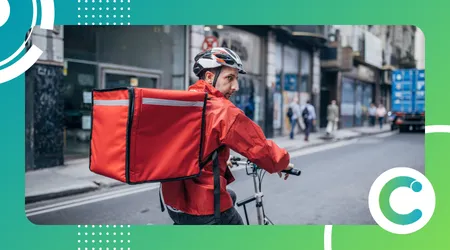
You open the app when you're hungry or feeling lazy, tap the screen, and fifteen minutes later, someone knocks on your door with exactly what you wanted at that moment. It feels like freedom.
But after a few months, the credit card statement tells a different story: small orders add up, fees accumulate, and what was once an exception becomes an invisible part of the financial routine.
Continue reading the text!
What does it really mean? effect of ultra-fast delivery today?
THE effect of ultra-fast delivery It arises when the promise of delivery in minutes removes almost all friction between wanting and having.
Advertisements
Previously, leaving home or waiting for hours created a natural pause to rethink the necessity.
Now, quick commerce and dark stores scattered throughout neighborhoods are transforming impulse buying into immediate action.
There's something unsettling about this. Speed doesn't just solve a problem—it redefines what we consider a problem.
A package of cookies that ran out, an afternoon coffee break that wasn't planned, even a stack of batteries that "gives us time" to arrive before the meeting.
Each of these moments seems harmless. Together, they create a fragmented and more expensive consumption pattern.
In Brazil in 2026, the phenomenon gained momentum with the accelerated expansion of the model.
What started as a solution for large cities is now reaching medium-sized neighborhoods, changing not only what we buy, but also how often and how we manage our daily money.
Read also: Credit strategies for those with a history of defaulting on payments.
As the effect of ultra-fast delivery Does it change the way you buy?
The brain loves quick gratification. When the interval between desire and fulfillment shrinks to minutes, reflection loses its place.
Orders that previously required a trip to the market now come from a quick scroll on the sofa.
Many people are starting to break down their shopping: instead of an organized weekly list, they end up making several small purchases throughout the week.
Each one seems cheap on its own. The problem appears at the end of the month, when the total reveals a constant leak.
THE effect of ultra-fast delivery It also encourages the replacement of old habits.
Cooking a simple meal or keeping a basic stock at home loses its appeal when the alternative arrives hot and effortless.
++ Earn extra money by selling underutilized space or items.
Gradually, planning gives way to instant reaction.
++ How the creator economy creates new business models.
Why the effect of ultra-fast delivery Does it weigh so heavily on the family budget?
Because it charges a double price: the value of the items and the invisible cost of convenience.
Delivery fees, tips, special packaging, and prices slightly inflated by the urgency add up silently.
Recent statistics clearly illustrate this trend: by 2025, spending on delivery services among Brazilian workers will have grown by 101%, reaching R$330 million via cards and benefits — a significant increase compared to the previous year.
It's not just more people ordering; it's delivery becoming a structural part of daily life.
The impact goes beyond the round number. Families who frequently adopt this habit report difficulty in predicting variable expenses.
What used to be "just today" becomes "almost every day," competing with fixed expenses and reducing the margin for unforeseen events or savings.
Think of the budget like an old hose, full of tiny holes. Each individual request is a minuscule hole. Individually, they're barely noticeable.
But, over time, the pressure eases and the bill at the end of the month is surprisingly high.
Real advantages and pitfalls that few admit to.
On the bright side, the service provides relief for those with busy schedules, parents of young children, or those facing mobility limitations.
It saves time — and, in some cases, reduces real logistical stress.
The trap appears when convenience becomes a crutch. Many people start avoiding even the most basic planning, relying on the app to solve almost everything.
The result is dependency and higher expenses than necessary.
Have you ever found yourself ordering something just because you "have time" before a meeting or because the app showed you an irresistible promotion?
This is one of the most common ways in which effect of ultra-fast delivery infiltrates.
Ease of judgment dulls critical thinking about what is truly urgent.
Two common stories that show the effect of ultra-fast delivery in practice
Lucas, an IT analyst who works remotely in São Paulo, initially only used delivery services for lunch.
Within a few months, the habit spread: breakfast, afternoon snack, even pharmacy items at random times.
By the end of 2025, he realized he was spending about R$ 450 more per month on small orders.
When she reviewed her statements, 60% were pure impulses. She reduced her usage to real-life situations and regained some control—and financial peace of mind.
Carla, a mother of two children in Curitiba, saw a practical advantage: she avoided taking her little ones to the supermarket at night.
But micro-deliveries of fruits, yogurts, and fresh bread have become a daily occurrence. Spending at the supermarket has fallen, but spending on delivery has risen so much that the total household expenditure has increased by almost 18%.
She created a simple rule — only order express delivery if you can't wait 48 hours — and managed to balance practicality with awareness.
These cases show that the effect of ultra-fast delivery It's not inherently good or bad.
It depends on how each person decides to integrate the service without letting it dictate the direction of the budget.
Frequently asked questions about effect of ultra-fast delivery
| Common question | Direct answer |
|---|---|
| Is ultra-fast delivery always more expensive? | Not always per item, but the overall cost usually increases due to fees and the higher frequency of orders. |
| How to control without sacrificing practicality? | Set a weekly or monthly limit and keep a list of planned purchases before opening the app. |
| Is it worthwhile for families with children? | It can be beneficial in moderation, but caution is needed to avoid completely replacing inventory planning. |
| Are rates rising? | Yes, they vary according to demand and time of day, which reinforces the need to evaluate the real cost-benefit ratio for each order. |
| Is there a way to reduce the impact? | Yes: combine deliveries, choose times with lower fees, keep basic supplies at home, and review everything before confirming. |
What remains after so many clicks?
THE effect of ultra-fast delivery This reflects a broader cultural shift: we increasingly value time and the absence of effort.
The challenge lies in not letting this appreciation cost more than we are willing to pay — or more than our budget actually allows.
Ultimately, all innovation brings trade-offs. Speed is here to stay.
The remaining question is how to navigate it with eyes open, without turning convenience into financial recklessness.
For those who want to read more:
- Spending on delivery services among workers will increase by 101% by 2025 – See
- Delivery on the rise: market expected to generate over US$21 billion in Brazil by the end of 2025 – ANR
- Quick Commerce in Brazil – Retail Trends 2026 – InfoPrice
Small, repeated choices every day shape our budget much more than we like to admit.
Ultra-fast delivery has only made this more visible — and more urgent to manage.
