
Advertisements
Zero fares in cities that have already adopted free transportation! Urban mobility is an essential pillar for the functioning of any city.
However, the cost of public transport fares often excludes portions of the population, limiting access to work, education and leisure opportunities.
In this context, the Zero Tariff, a public policy that eliminates fare collection on public transport, emerges as an innovative solution to democratize access to the city.
But how does this initiative actually work in the cities that have adopted it?
Why is it gaining strength in Brazil and around the world?
Advertisements
Continue reading and find out everything about it!
Zero fares in cities that have already adopted free transportation

Zero Tariff is not just a cost exemption, but a redefinition of transportation as a universal right.
Just as healthcare and education are guaranteed by the government in many contexts, free transportation aims to ensure that no one is left behind due to a lack of financial resources.
++ Using a Digital Account as a Salary Account: Is It a Good Idea?
However, implementing this policy requires robust planning, creative funding sources, and firm political commitment.
Below, we explore how Zero Tariff operates, its benefits, sustainability challenges, and the lessons Brazilian cities can teach the world.
What is Zero Tariff and how does it work?
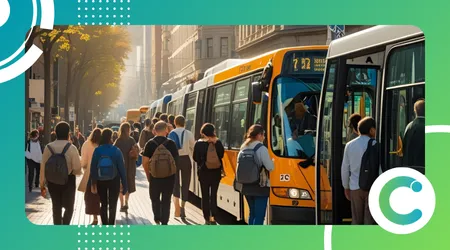
Zero Fare is a public policy that eliminates fare collection on public transportation, transferring the cost of the service to the public budget or other sources of revenue.
Unlike the traditional model, where transport companies are paid based on the number of passengers.
With Zero Tariff, payment is based on other criteria, such as kilometers driven or hours of service.
In suama, this allows transportation to be accessible to everyone, regardless of financial status.
For example, imagine a city as a living organism, where the streets are veins and public transport is the blood that keeps life pulsating.
Without the fare barrier, more people move around, connecting to jobs, schools, and essential services.
This model requires the municipality to assume responsibility for financing the system, often using progressive taxes, natural resource royalties, or partnerships with the private sector.
Furthermore, Zero Tariff often encourages the restructuring of bus routes, expanding coverage and service efficiency.
++ Extra Income with Text Translation: Practical Guide
In Brazil, Zero Tariff gained traction especially after the 2013 protests, when the Free Fare Movement highlighted the exclusion caused by high fares.
Since then, cities such as Maricá (RJ) and Caucaia (CE) have successfully implemented the model, showing that it is possible to break the vicious cycle of rising fares and falling passengers.
However, success depends on transparent management and planning that balances growing demand with quality of service.
Benefits of Zero Tariff: Beyond Savings
Zero Tariff goes far beyond easing the burden on citizens' pockets.
First, it promotes social inclusion, allowing low-income populations to access urban areas previously restricted by the cost of transportation.
In Maricá (RJ), for example, the demand for public transport grew sixfold after the adoption of the Zero Tariff in 2014, with more than 120 thousand people transported daily.
This increase reflects pent-up demand, where citizens who previously walked long distances or avoided commuting now move freely.
Furthermore, the policy stimulates the local economy.
++ How to have fun without spending a lot: Cheap and Creative Leisure
With more money available, families can spend on goods and services, boosting commerce.
In Caucaia (CE), the city hall reported an increase in sales in local businesses after the implementation of the Zero Tariff, as residents began to visit shopping centers more.
Additionally, reducing the use of private cars helps reduce traffic jams and pollutant gas emissions, aligning with urban sustainability goals.
Finally, Zero Tariff strengthens the sense of belonging to the city.
When transportation is free, people participate more in cultural events, visit public spaces, and connect with their communities.
It is no wonder that 145 Brazilian cities, benefiting more than 5.4 million people, adopted Zero Fare by March 2025, according to the National Association of Urban Transport Companies (NTU).
But could all Brazilians enjoy this right?
The universalization of the policy still faces significant barriers, which we will explore below.
Implementation Challenges: Planning is Key
While Zero Tariff is an attractive idea, its implementation requires overcoming complex challenges.
First, financing is a central issue.
In small cities, such as Conchas (SP), which has adopted Zero Tariff since 1992, the annual cost of R$ 247 thousand is viable due to the reduced fleet and the population of only 18 thousand inhabitants.
However, in large urban centers such as São Paulo, the estimated annual cost of R$1,400,000 for free Sundays only illustrates the scale of the financial challenge.
Furthermore, increased demand can overload the system.
In Caucaia (CE), the bus fleet needed to grow from 48 to 70 vehicles to handle the increase from 505,000 to 2.2 million monthly passengers.
Without proper planning, overcrowding and declining service quality are real risks.
Therefore, cities that adopt Zero Tariff invest in demand studies and reorganize routes to ensure efficiency.
Furthermore, another challenge is political and economic resistance.
Transportation companies, accustomed to the per-passenger pay model, may oppose the change.
Furthermore, managers face pressure to prioritize other sectors, such as health and education, within already tight budgets.
Thus, Zero Tariff requires not only resources, but also political will and creative financing strategies, such as taxes on local businesses or redirecting funds from road infrastructure.
Practical examples: Maricá and São Caetano do Sul
Maricá (RJ): A model financed by royalties
Maricá, in Rio de Janeiro, is an emblematic example of the success of Zero Tariff.
Since 2014, the city, which has around 212,000 inhabitants, has operated a free transport system financed mainly by oil royalties.
The Public Transport Company (EPT) manages a fleet of buses known as “little red ones”, which transport more than 120 thousand passengers per day.
The initiative, initially seen as bold, transformed local mobility, reducing dependence on individual transport and strengthening the economy.
Maricá's secret lies in the state management of the system and the use of a stable source of revenue.
Additionally, the city has integrated free bicycles into the system, promoting intermodality.
This model demonstrates that, with sufficient resources and planning, Zero Tariff can be scalable even in medium-sized cities.
However, dependence on royalties raises questions about replicability in municipalities without extraordinary revenues.
Finally, the social impact is undeniable.
Residents report greater access to health and education services, as well as a sense of belonging to the city.
Maricá proves that Zero Tariff is not just a transportation policy, but a tool for urban transformation.
São Caetano do Sul (SP): Zero Fare in a metropolitan city
São Caetano do Sul, in the metropolitan region of São Paulo, adopted Zero Tariff in November 2023, becoming the largest city in the state to implement the policy universally.
With 165,000 inhabitants, the city finances the system with resources from the municipal budget, estimated at R$1,400,000,000 annually.
The initiative was made possible by the economic stability of the municipality, which has high per capita revenue.
Unlike Maricá, São Caetano operates with a private fleet contracted through a bidding process, but maintains free access for all users.
The policy resulted in more than 27 million free trips in just over a year, according to the city government.
Additionally, the city saw a 15% reduction in car traffic, relieving congestion and improving air quality.
The case of São Caetano shows that Zero Fare is viable in metropolitan contexts, where integration with other modes, such as trains and subways, can be a challenge.
The city is now evaluating expanding its fleet to meet growing demand, highlighting the importance of continuous adjustments to maintain service quality.
Financing models: How to pay for Zero Tariff?
Financing is the heart of Zero Tariff. Cities typically use public resources, such as municipal or state taxes, to fund the system.
For example, in Vargem Grande Paulista (SP), local companies pay a fixed fee per employee, replacing the traditional transportation voucher, which redistributes costs equitably.
This creative approach reduces pressure on the municipal budget and engages the private sector in policy.
Another strategy is the use of extraordinary revenues, such as oil royalties in Maricá or taxes on specific economic activities.
In smaller cities, such as Caeté (MG), the monthly cost of R$ 90 thousand is absorbed by the municipal budget without major difficulties.
However, in large centers, such as São Paulo, the proposal for a Unified Mobility System (SUM), inspired by the SUS, suggests a shared financing model between the federal government, states and municipalities.
The table below summarizes the main financing models observed in Brazilian cities with Zero Tariff:
| City | Funding Source | Estimated Cost | Population |
|---|---|---|---|
| Marica (RJ) | Oil royalties | R$ 7.3 million/month | 212 thousand |
| Sao Caetano do Sul (SP) | Municipal budget | R$ 27 million/year | 165 thousand |
| Shells (SP) | Municipal budget | R$ 247 thousand/year | 18 thousand |
| Vargem Grande Paulista (SP) | Fixed rate for companies (replaces transportation vouchers) | R$ 1.2 million/year | 52 thousand |
Social and Economic Impacts: A Silent Transformation
Zero Tariff not only makes travel easier, but also transforms the social and economic dynamics of cities.
In social terms, the policy reduces inequalities by allowing vulnerable populations to access essential services.
For example, in Luziânia (GO), residents save around R$130 per month with free access, an amount that can be used for food or education.
This impact is especially relevant in peripheral areas, where transportation costs consume a significant portion of income.
Economically, Zero Tariff stimulates local commerce and reduces public health costs.
Cities like Maricá report an increase in tax collection due to the greater circulation of people.
Furthermore, reducing the use of private cars reduces traffic accidents, relieving the burden on healthcare systems.
In environmental terms, the policy contributes to reducing emissions, aligning with the UN Sustainable Development Goals.
However, the success of these impacts depends on the quality of the service.
Overcrowding and lack of maintenance can frustrate the benefits, as observed in Palmas (TO), where abrupt implementation led to crowding problems.
Thus, Zero Tariff requires a balance between accessibility and efficiency to fulfill its transformative potential.
Frequently Asked Questions about Zero Tariff
| Question | Response |
|---|---|
| Does Zero Fare increase bus overcrowding? | Yes, demand can increase significantly, as in Caucaia, Ceará, where it increased by 3,711 TP3T. However, with planning and fleet expansion, overcrowding can be avoided. |
| How do cities finance Zero Tariff? | Most use the municipal budget, but some, like Maricá (RJ), use oil royalties, while others, like Vargem Grande Paulista (SP), create taxes for companies. |
| Is Zero Tariff viable in large cities? | It is more challenging due to the high costs, but cities like São Caetano do Sul (SP) show that it is possible with planning and robust revenue sources. |
| Does free service reduce the quality of service? | Not necessarily. With efficient management, as in Maricá (RJ), quality can be maintained or even improved by expanding the fleet and restructuring routes. |
| Is Zero Tariff sustainable in the long term? | Yes, as long as there are stable funding sources and continuous planning, as demonstrated by Conchas (SP), which has maintained the policy since 1992. |
The Future of Zero Tariffs: A Universal Right?
Zero Tariff represents a paradigm shift in urban mobility, treating transportation as a right, not a commodity.
In Brazil, the growth from 20 cities with Zero Tariff in 2019 to 145 in 2025 signals a promising trend.
However, universalizing the policy requires a national debate on financing, with proposals such as the Unified Mobility System (SUM) gaining momentum in Congress.
Despite the challenges, Zero Tariff has already proven its worth in cities like Maricá and São Caetano do Sul, where social inclusion and economic development go hand in hand.
The question remains: if transportation is a constitutional right, why do we still pay to access it?
With planning, innovation, and political will, Zero Tariff can become not just a local reality, but a national policy that transforms Brazil.
