

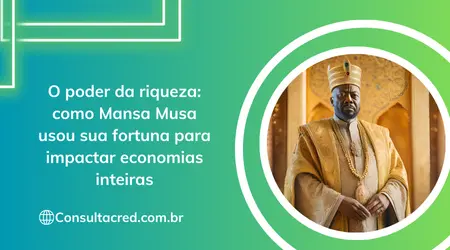
Mansa Musa: The King of Mali and His Unparalleled Fortune
Advertisements
Mansa Musa, known as the richest ruler in history, left an impressive legacy both in terms of wealth and cultural and economic impact.
His empire, Mali, prospered between the 13th and 14th centuries, controlling vast reserves of gold and salt, which positioned it as a major player in West African trade routes.
However, Musa did not simply accumulate wealth; he used it strategically to strengthen his empire, improve social conditions, and gain influence in international spheres.
His fortune, which today would be equivalent to around 400 billion dollars, was used to transform the economic structure of several regions and solidify Mali as a center of knowledge and power in Africa and beyond.
This fortune had profound effects on the economies and cultures that Mansa Musa touched throughout his life.
Below, we delve into the journey of how he accumulated and utilized these resources, especially during the famous pilgrimage to Mecca in 1324.
Every action he took was carefully planned to cement his legacy, and his contributions shaped the economic landscape of the Islamic world and Africa in unique ways.
The Wealth and Famous Pilgrimage of Mansa Musa
The pilgrimage to Mecca, one of the pillars of Islam, became the most famous event in Mansa Musa's life, cementing his reputation as the richest man in the world and as a generous leader.
In 1324, he set out on a journey of more than 4,000 km to Mecca, accompanied by an immense retinue: some 60,000 men, including soldiers, merchants and servants, as well as a vast number of camels and horses.
Each of these camels carried a considerable amount of gold, and during the journey, Musa distributed wealth to various cities and populations.
It is estimated that the gold distributed by Mansa Musa in cities such as Cairo, Medina and Mecca was so abundant that wherever he went, the local economy was profoundly impacted.
+ Share Capital: what it is and how to define it in your business
Below, a table illustrates the effect of this gold on the main cities through which his entourage passed:
| City | Amount of Gold Distributed (estimate) | Economic Effect |
|---|---|---|
| Cairo | Approximately 1 ton | Inflation up to 12 years |
| Mecca | Over 500 kg | High prices of local products |
| Medina | Inaccurate values | Expansion in infrastructure and temples |
In Cairo, for example, the amount of gold in circulation was so great that prices rose dramatically, and this inflation lasted for more than a decade.
The sudden wealth, while bringing improvements to many communities, also created temporary instability, revealing the impact that an excessive circulation of resources can have on a local economy.
Mansa Musa's Investment in Mali: Education, Religion and Culture
Mansa Musa not only distributed wealth on his travels; he also invested it in his own empire, especially in Mali, which became a vibrant center of learning and culture.
In Timbuktu, a city that became an educational and spiritual landmark, he financed the construction of mosques, universities and libraries, attracting scholars and scholars from across the Islamic world.
The University of Sankore, which he funded, became one of the greatest centers of learning of the time, where subjects such as mathematics, astronomy, law and medicine were widely explored.
These initiatives helped Mali become not only a commercial center but also an intellectual powerhouse.
Furthermore, investment in architecture consolidated Mali's cultural influence, whose impressive mosques and buildings still stand today as symbols of its time of splendor.
For Mansa Musa, wealth did not only mean economic power, but also the responsibility to strengthen society.
The city of Timbuktu became, in the words of the chroniclers of the time, “the jewel of the desert”, a meeting place for intellectuals and religious leaders.
+ 10 Habits Financially Successful People Have in Common: The Path to Prosperity
The Economic Impact of Mansa Musa's Trade Policy
Mansa Musa's economic policy was another determining factor in Mali's prosperity.
Taking advantage of the empire's strategic location on the trans-Saharan trade routes, he expanded the salt and gold trade to regions such as the Middle East, North Africa and even Europe.
As a result, Mali became an essential point on the trade routes that connected sub-Saharan Africa with the Arab and Mediterranean world.
Below, a table details the main products and routes that drove trade under Mansa Musa's leadership:
| Product | Main Trade Routes | Markets Reach |
|---|---|---|
| Gold | Trans-Saharan, going north and east | Middle East, North Africa, Europe |
| Salt | Internal and trans-Saharan | Sub-Saharan and North Africa |
| Ivory | Export to the Mediterranean and beyond | North Africa and Europe |
These trade routes strengthened not only Mali's economy, but also the empire's geopolitical position, placing it as a reference in trade and influencing economic policies beyond its borders.
In this way, Mansa Musa was able to secure a steady source of revenue for the empire, which allowed for more investment in infrastructure, education and religion.
Mansa Musa as an Example of Wealth Management and Social Responsibility
Mansa Musa's legacy goes beyond the accumulation of wealth; he left an example of how a leader can use his resources for collective development.
He understood that wealth can serve as a channel to strengthen communities and inspire cultural and economic progress.
Today, the example of Mansa Musa is often cited in economic and political studies as a case of using economic power to promote public welfare.
Experts point out that Musa's impact can be seen in how Mali continued to flourish even after his death.
The city of Timbuktu remained a center of learning for centuries, attracting intellectuals from different places.
This was only possible due to Musa's long-term vision, as he applied his wealth to strengthen society as a whole, rather than focusing solely on his own glory.
“The greatness of a leader is not in his wealth, but in what he does with it.”
The Lasting Legacy and Its Current Relevance
Centuries after his death, Mansa Musa's name still resonates as one of the greatest examples of economic power and its capacity for social transformation.
Modern economists and historians look to his story as a model of how wealth can be used ethically and strategically.
His example reminds us that wealth has a transformative power not only for those who possess it, but for the whole of society, when well managed.
Mansa Musa's lessons remain relevant in today's world, where the debate about the social responsibility of individuals and companies is increasingly important.
He teaches us that true wealth goes beyond financial accumulation: it lies in the ability to create opportunities for education, in promoting sustainable economic development and in preserving knowledge and culture.
In times of growing social inequality, Mansa Musa's story is an inspiration for leaders and entrepreneurs seeking to make a difference in the world.
Final Considerations
Mansa Musa was not just a wealthy ruler; he was a visionary leader who used his resources to impact future generations.
He invested in culture, education and infrastructure, transforming Mali into a symbol of prosperity and knowledge.
His journey to Mecca, however extravagant, symbolized his commitment to his faith and his ambition to position Mali on the world stage.
Today, his example stands as a reminder that wealth can have lasting impact when used to promote the common good.
When you study Mansa Musa's legacy, you can see that he represents the pinnacle of how wealth and power can be applied to create a more just and progressive society.
With the visionary gaze of Mansa Musa, Mali flourished as a beacon of culture and knowledge, an example that echoes through the centuries.
Mansa Musa's fortune was thus more than a symbol of power — it was a tool of transformation, not only for his time, but for all ages to come.
