

Advertisements
Personal credit or business credit? What would be the best option?
There are several credit options on the market, both for individuals and legal entities.
This certainly helps a lot for people who are trying to get their business off the ground or make their individual dreams come true.
However, it is important to know the differences between both, to decide which one is best for your conditions.
In fact, making a careful decision about which credit is best will allow you to take advantage of the benefits in the best possible way.
What is personal credit?
In principle, personal credit or personal loan consists of the same thing, an amount is lent to the customer by a financial institution.
These institutions can be banks, fintechs and credit unions. The loan is granted after a credit risk analysis and with the application of interest rates, which vary according to the institution and modality.
According to the Central Bank of Brazil, the non-consigned personal credit rate for individuals between November and December 2023, varied from 0.07% to 4.76% in the month.
In short, the variation occurs because financial institutions carry out the analysis when providing credit, and assess the risk they run when lending money to the client.
Keep in mind that there are no guarantees with personal credit; the greater the risk, the greater the possibility of default.
Furthermore, the process is very simple: the customer requests an amount from a financial institution, and after credit analysis, it decides whether or not to transfer the amount to the customer.
It is worth noting that interest rates and rules vary depending on the institution providing the credit, everything will happen according to each company's policy.
Between the personal credit or business credit, people usually get a faster release.
In this sense, the documents requested in the process are only the ID and CPF, depending on the institution of course, there are some that ask for proof of residence and income.
+ Loan without bureaucracy: is it worth it?
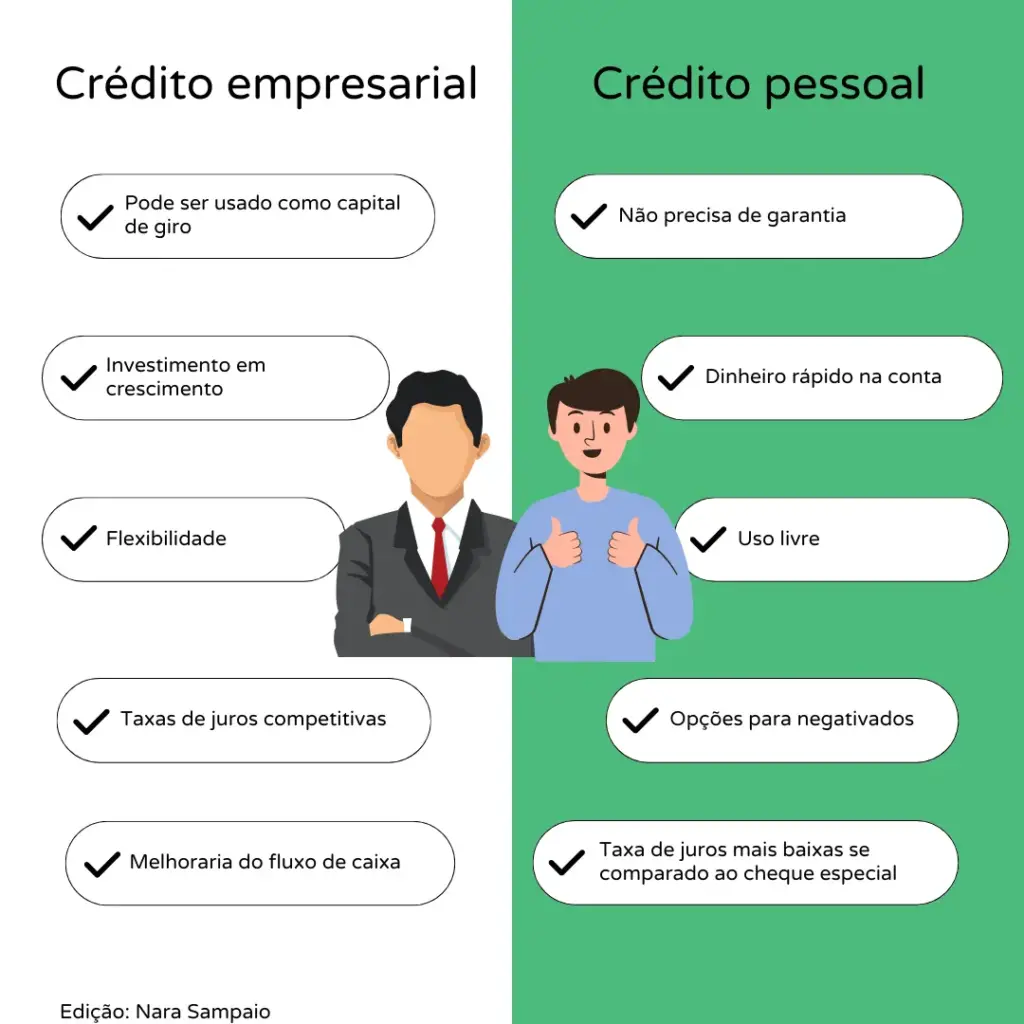
See some advantages of personal credit:
- No-strings-attached loan: the only guarantee is the customer's word, in addition to the credit analysis that will be carried out;
- Secured loan: in this option, an asset is offered as a guarantee of payment, such as a car or property;
- Quick money in the account: after approval, the credit amount is deposited into the person's account within a maximum of one business day. There are cases in which the bank leaves a pre-approved amount, to be released via the internet, ATM, or app;
- More advantageous than an overdraft: for those who have an account and are in the habit of paying everything on time, a personal loan is better than using an overdraft on their account;
- Serves those with bad credit: there are some credit instructions that provide personal loans for those with bad credit, which is rare in banks;
- The loan amount can be used in any way you wish;
- Lower interest rates compared to overdraft.
What is business credit?
Firstly, business credit is a loan made available to companies in various sectors and of different sizes.
The aim is to strengthen the company and carry out development projects.
This type of credit can be used in a variety of ways and forms: purchasing equipment, expanding businesses, investing in marketing and increasing inventory, among others.
In this sense, when the loan is for small and large companies, the difference is that the form of credit can change depending on the reason for requesting the loan and the follow-up.
In short, the entrepreneur seeks direct credit from the bank or other financial institutions.
When this loan is well managed by the company, it can help in the development of the business.
Small Business Loan: Best Options for You
See the different types of business credit
There are several types of business credit available on the market, see what they are:
Line of Credit for working capital: is a loan that meets the need for financial resources to maintain the company's activities, such as paying suppliers, salaries and other operating expenses.
Loan with collateral: this loan is made available based on payment guarantees, whether vehicles or machinery, among others.
In short, secured loans have lower interest rates and longer terms than other types of business credit.
Anticipation of receivables: in this type of loan, the company receives the value of its sales in advance, allowing it to finance its activities without waiting for customers to pay.
Factoring: This is a way in which the institution acquired the receivables from another smaller company, at the nominal value and advanced the amount to the selling institution.
The amounts are in post-dated checks, duplicates or promissory notes.
Advantages of business credit
See the advantages for companies seeking financing for their operations and projects:
1. Working capital: Business credit allows the company to have access to working capital to cover operating expenses, such as payment to suppliers, salaries and other obligations.
This helps maintain the continuity of business activities.
2. Investment in Growth: With business credit, companies can invest in expansion, new equipment, technology, marketing and other areas that drive growth. This is essential to remain competitive in the market.
3. Flexibility: There are different types of business credit available, such as secured loans, revolving lines of credit and receivables anticipation.
This gives you the flexibility to choose the option that best suits your company’s specific needs.
4. Competitive interest rates: depending on the company's financial situation and the type of credit chosen, interest rates can be competitive.
This allows the company to obtain financing at reasonable costs.
5. Improved cash flow: Business credit can help improve cash flow, especially when there is seasonality in sales. Anticipation of receivables and revolving lines of credit are examples of this.
6. Building credit history: By using business credit responsibly and efficiently, the company builds a positive credit history.
This may be useful for future financing needs.
7. Possibility of negotiation: companies with a good credit history can negotiate better terms with financial institutions.
This includes lower interest rates and more favorable terms.
Conclusion
Personal credit or business credit? Each credit available on the market has its advantages and benefits, both for individuals and legal entities.
Therefore, it is worth highlighting that each situation must be analyzed carefully, especially the charges and terms involved.
Ultimately, you will decide which is the best option, opting for the loan that best suits your financial conditions and doesn't get your finances out of control.
