
Advertisements
Virtual vs. Physical Cards: Imagine paying for an online purchase without revealing your real credit card number.
Or, on the other hand, you could slide a piece of plastic into a machine and feel the transaction happen instantly.
The choice between virtual vs physical cards It's not just about convenience — it involves layers of security, cost variations, and specific usage contexts.
In this text, we will explore these aspects with solid arguments, real-world examples, and a critical perspective that goes beyond the obvious.
Find out everything below!
Advertisements

What are virtual and physical cards?
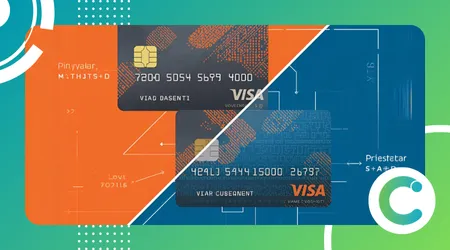
Firstly, physical cards are tangible objects issued by banks or fintech companies.
They contain a chip, a magnetic stripe, and often contactless technology.
In contrast, virtual cards exist only in the digital environment — generated by apps or banking platforms for specific transactions.
Furthermore, while the physical requires the production of material (PVC, embedded chip), the virtual is merely a sequence of numbers with temporary validity.
This fundamental distinction already anticipates differences in costs and risks.
For example, a lost physical card can be canceled, but the damage has already occurred; a virtual card, on the other hand, can be discarded without leaving a trace.
In terms of functionality, both serve the same purpose: to authorize payments.
However, the physicist has a history – he's been a veteran of these transactions since the 1950s.
The virtual world, in turn, emerges as a response to online shopping, which today represents more than 201% of global retail, according to... Statista (2024).
How do they work in practice?
Initially, the physical card operates by reading a chip or magnetic stripe.
The payment terminal sends data to the bank, which approves or denies it in seconds.
In this process, the bearer needs to be present, which adds a layer of personal control.
On the other hand, the virtual card is generated instantly via the app. You set the limit, validity, and even a specific merchant. After the transaction, it can be deleted.
This flexibility eliminates the need to carry plastic, but requires a stable internet connection.
++ How to Earn Extra Money with Online Microtasks: What Works
Comparatively, physical cards allow withdrawals from ATMs — something that virtual cards rarely offer.
Meanwhile, virtual plans shine in recurring subscriptions, as they can be replaced without affecting the core service.
What are the differences in security?
First, physical cards face tangible risks: magnetic stripe cloning, theft, or loss.
Banks are combating this with EMV chips, which generate unique codes for each transaction.
Still, in 2023, fraud involving physical cards accounted for 62% of cases in Brazil, according to Abecs.
Next, virtual cards operate using tokenization. The real card number is never exposed — the merchant receives a temporary "token".
Therefore, even if the site is hacked, the stolen data is useless. This is a technical advantage that drastically reduces the impact of data breaches.
However, the virtual world is not immune. Phishing and social engineering can trick users into generating cards on fake websites.
++ How to Build a Digital Presence for a Local Business in Medium-Sized Cities
Thus, security depends less on technology and more on user behavior.
How Much Does it Cost to Maintain Each Type?
Initially, physical cards involve issuance costs (R$ 20 to R$ 50), annual fees (up to R$ 1,200 on premium cards), and fees for withdrawals or international transactions.
Furthermore, replacement for loss costs time and money.
On the other hand, virtual cards are usually free. Fintech companies like Nubank and PicPay don't charge for issuance or maintenance.
However, some traditional banks limit the number of virtual cards per month, forcing paid upgrades.
Looking at the long term, physical cards might be more expensive in terms of annual fees, but they offer benefits like points and cashback.
The virtual world saves on fees, but rarely accumulates equivalent rewards.
| Aspect | Physical Card | Virtual Card |
|---|---|---|
| Emission | R$ 0 to R$ 50 | Free |
| Annuity | Up to R$ 1.200 | R$ 0 |
| Replacement | R$ 20 to R$ 50 | Instant and free |
| Benefits | Points, VIP lounges | Custom limits |
When to Opt for Virtual Cards?
First, use virtual cards for one-off online purchases. For example, when testing a new e-commerce site, generate a card with the exact purchase limit.
Therefore, even in the case of fraud, the loss is zero.
Additionally, when traveling internationally, create virtual cards for each reservation (hotel, car rental). If one service leaks data, the others remain secure.
This strategy is especially useful in countries with a high incidence of skimming.
Finally, for subscriptions, set up a virtual card that renews monthly.
This way, you control expenses and avoid surprises with automatic renewals.
When Will Physical Cards Still Reign?
Initially, in establishments without internet access or with offline payment terminals, physical payment is indispensable.
Shops in rural areas or open-air markets rarely accept offline digital payments.
Next, for emergency withdrawals, only physical cash allows immediate access to the money.
Although Pix has reduced this need, in situations of general internet outages, plastic cards are a lifesaver.
Furthermore, in high-value in-person transactions (real estate, vehicles), physical means offer physical traceability — the seller sees the bearer, reducing the risk of money laundering.
Practical Examples of Intelligent Use
Ana, a freelancer, receives international payments. She generates a virtual card for each client, with an exact credit limit.
When a customer is late with a payment, she simply deactivates the card—without canceling the main account.
As well as, Pedro is traveling to Thailand.
In this sense, instead of carrying physical cards, he creates three virtual ones: one for lodging, another for transportation, and a third for emergencies.
Upon returning, it deletes them all. The result? Zero risk of cloning on suspicious devices.
Ultimately, a physical card is like a house with doors and windows — solid, but vulnerable if someone breaks in.
A virtual card is like a temporary safe inside your house: you only open it for what you need and lock it immediately.
What is the best choice for you?
What if you could have both worlds? The answer isn't binary. Most modern banks offer both.
Therefore, the winning strategy is a hybrid one: physical for day-to-day in-person interactions, and virtual for riskier digital interactions.
| Scenario | Recommendation |
|---|---|
| One-time online purchases | Virtual |
| Offline withdrawals and payments | Physical |
| Recurring subscriptions | Virtually renewable |
| International travel | Virtual multiples |
Virtual vs. Physical Cards: Frequently Asked Questions
| Question | Response |
|---|---|
| Can I use a virtual card in physical stores? | Rarely. Some allow it via Apple Pay/Google Wallet, but they depend on NFC on the phone. |
| Does a virtual card accumulate points? | It depends on the bank. Nubank simulates it, but with a lower limit than the physical one. |
| Is it safe to generate multiple virtual cards? | Yes, as long as it's on official apps. Avoid suspicious links. |
| Can I transform the physical into the virtual? | Not directly, but some banks allow you to "mirror" credit limits. |
Virtual vs. Physical Cards: Relevant Links:
